Revenova TMS Release Notes

Prev Next

Fall ’25 Release Enhancements

Brokerage & Fleet Enhancements

🚀 Artimus™ 2.0: Smarter Load Quoting Powered by AI and TMS

Artimus 1.0 gave our customers a more innovative way to create loads, quote rates, and post trucks—directly from email or within the TMS.

Artimus 2.0 elevates that experience to the next level, making quoting faster, easier, and more flexible.

With Artimus 2.0, you can now create and quote any single-pickup/single-dropoff load using a combination of AI and our TMS logic. Whether your team sends an email or uses our Text to Load LWC, Artimus parses the data and returns a dynamic new AI Load Wizard LWC with:

  • A prefilled Load form

  • Quotes (if enough data is provided) based on stored rate entries or carrier-marked-up rates

  • Options to update the Load information, re-quote, and accept/reject quotes

  • A Customer Portal experience without the need to log in

We’ve also added Mode configurability, allowing you to define which fields Artimus should process. The TMS also packages default fields with values in the AI Console for LTL and non-LTL Modes.

Send custom email responses with our new email templates to customers, letting them use the AI Load Wizard LWC.

The best part of Artimus 2.0? We use AI only at the initial parsing stage, then hand off the data to our LWC interface.

This light-touch approach to large language models (LLMs) helps prevent AI hallucinations and avoids frustrating feedback loops, giving your team more control, accuracy, and confidence in every quote.

Additionally, Artimus 2.0 will now be able to process Equipment Type on Truck Postings, which will allow truck postings to be visible in LaneIQ Truck - Load Match.

How It Works

  1. Select which Modes should be AI-enabled.

  2. Configure which fields Artimus should parse by Mode in the AI Console Configuration.

  3. When a customer sends an email to Artimus or the Text to Load LWC is used, Artimus will parse the text, create a Load record (if enough information is provided), and send an email.

  4. The customer can adjust the Load information as needed in the AI Load Wizard LWC and get quotes. Then, they can accept or decline quotes all from the email they received.

Appointment Console

Take greater control of setting the appointment information for Load locations with the new Appointment Console available for both brokerage and fleets.

View customizable Load, Stop, and Line Item information directly in the console and filter based on several fields to set the appointments necessary for moving freight.

Contact information is available for each Stop location for setting and confirming appointments.

Appointment Console information is available here.

For Fleet Appointment setting, see information for creating Appointment views and Appointment Setting.

Deficit Rating in Stored Rate Entries

You can now apply the new built-in deficit rating functionality to new and existing stored rate entries.

Paying for a small amount of additional weight (called deficit weight) can result in a better overall rate compared to paying the actual weight of the load. Utilize this new built-in feature to offer your customers a more favorable rate in the long run.

Create a weight-based Rate Entry where the pricing structure is tiered, with the rate decreasing as the weight increases. Enable the deficit rating feature so the TMS can determine if it is better to rate at the next weight tier than the actual weight.

""

If rating the actual weight at the next weight tier is more cost-effective, then the deficit rate is applied to the quote with a note automatically applied.

""

This feature also applies to billable weight-based rate entries, where your rate is based on the Billable Weight rather than the Total Weight of the Load.

Fleet Enhancements

Enhance your Trip Planning with Trip Builder

Create, manage, and dispatch complex multi-modal and LTL Loads directly from the Fleet Management Console. The new components provide a workflow that is flexible to adapt to different use cases and processes.

A streamlined Freight Plan Console provides a simple interface to separate Customer Loads into Carrier Loads for consolidation. Add Carrier Load Expected Ship Date and Expected Delivery Dates right from the Console when creating them.

The new Trip Builder component allows for freight plans and trip plans to work together. First, use the Freight Plan modal to split and consolidate carrier loads. Then, use the Trip Builder to build those carrier loads into Trip Plans.

This new process simplifies the planning and execution of complex Trip Plans to efficiently move cargo from pickup to delivery.

Freight Plan Load Views

The new Freight Plan Load views allow fleet customers to track and manage their freight plans right from the Fleet Management Console.

Track deliveries and pickups in a single location with the filters in the Freight Plan Load view. Simply search for and select a shipping/receiving location from your network to view the status of the deliveries and pickups going into and out of that location.

Manage every detail of your Fleet Loads using the Detail View. Confirm Customer Load details more quickly by viewing additional Customer Load information. Now you can look at not only summary information for each Load but also details for the related Stops and Line Items. Make your Freight Plan Load views a one-stop shop for all important Customer Load data.

Trip Plan Views

Create highly customizable views to manage Trip Plans in the Fleet Management Console. Quickly filter your list of Trip Plans based on the assigned driver, assigned vehicle, load shipping location, trip plan dates, and much more.

Detail View

Manage every detail of your Fleet Trip Plans using Detail View. Confirm Trip Plan details more quickly by viewing additional information by Trip Plan, Leg, Leg Asset, and Segment. View summary information for each Trip Plan and click to drill down into details like ETA, Trailer Number, Appointment Times, and much more. Make your Fleet Trip Plan views a one-stop shop for all important Trip Plan data.

Manage Trip Alert Notifications from Trimble

Limit the number of Trip Event notifications in the Fleet Management Console to those that matter most to you.

Turn on, turn off, or temporarily suspend Trip Event notifications from Trimble Maps when managing Fleet Trip Plans. Control the Trip Event alerts for Carriers Fleet-wide, by Stop location, or by individual Trip Plan Segments.

Trimble alerts are also more accurate in the Fall ’25 release thanks to new data points captured on the Stop and in the Trip Plan Leg.

Revenova now allows you to keep track of the amount of time it takes to load or unload at a given shipping/receiving location. This information helps derive more accurate ETAs, shipper/receiver scorecards, and driver retention. The TMS also allows you to differentiate the dwell times for a Stop location based on the Cargo Status and Pickup/Delivery Stop types.

Additionally, you can now default the loading/unloading type at the Transportation Profile level.

Dispatch Trips with the Catena Integration

The Revenova Fleet module allows customers to send Trips to the Driver’s ELD apps with the click of a button. With this new connection between the TMS and the ELD, dispatching Drivers from Revenova has never been easier. Drivers now have all of the same Trip addresses, dates, loading types, and more from the TMS in their ELD app.

Supported ELD integrations also allow customers to configure when the TMS sends the Trip to the Driver. Send Trip information when the Driver has accepted the Trip Plan or when the Segment is Dispatched. See more information here.

Miscellaneous Enhancements

  • The architecture for several triggers is enhanced for the Fall ’25 release. Thoroughly test that any custom code based on these triggers is working properly. The following triggers are impacted: AccessorialExclusionUpsert, ACENotificationUpsert, Driver, EManifestTransactionUpsert, RNSNotificationUpsert, StopUpsert, TransportationProfileUpsert, TripPlanLeg, TripPlanLegAccessorialUpsert, and TripPlanSegment.

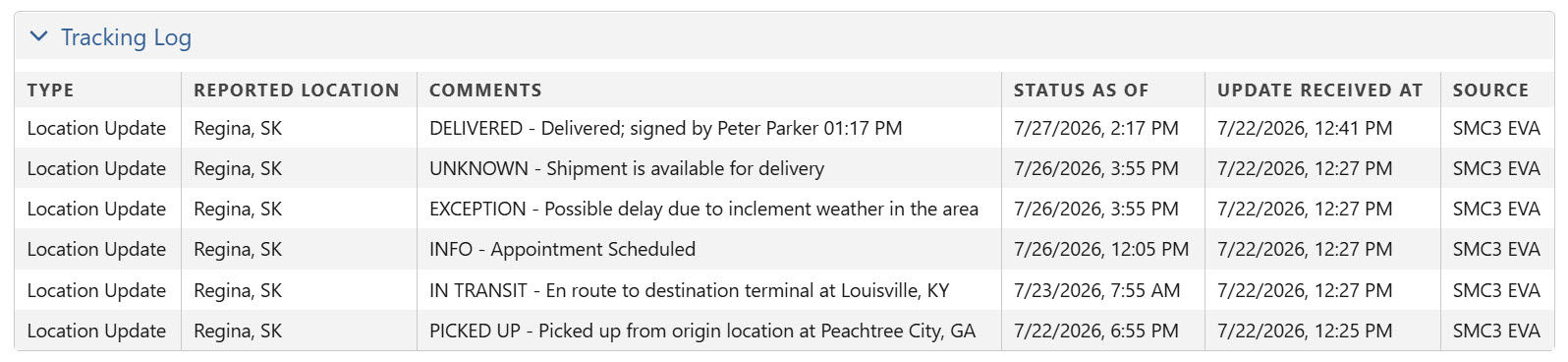
  • The MacroPoint integration for carrier tracking adds the ability to begin a second tracking session for a Load. From the Carrier Banner, enter the required tracking information and continue tracking a Load in transit.

  • Enhancements to the Hubtran integration provide the ability to send additional fields for auditing LTL Loads. Add fields to four new field sets for more precise control of when Load-related fields are sent or updated to Hubtran.

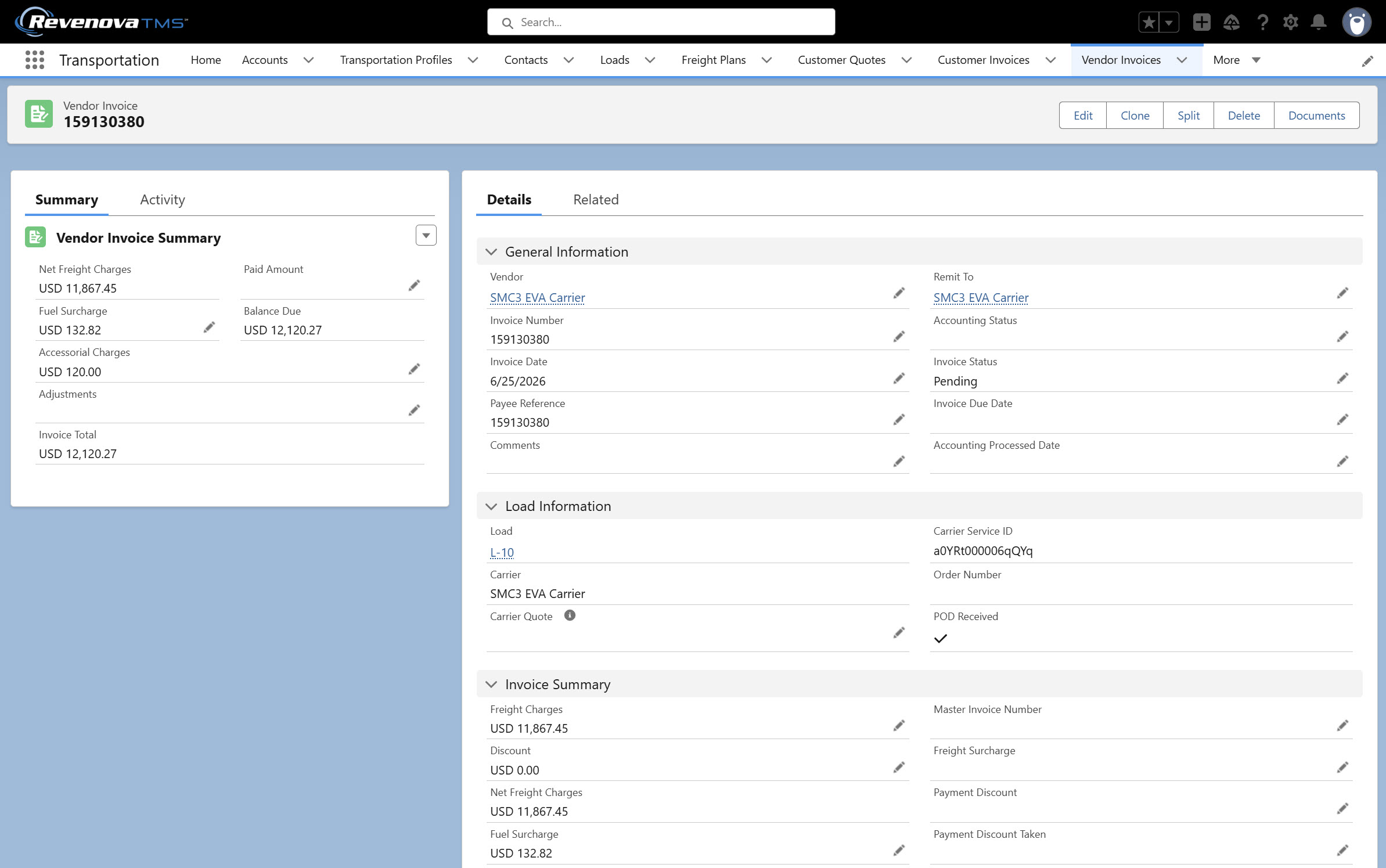
  • Vendor Invoices are generated with the Vendor field populated from the Carrier Quote on the Load. The Vendor on the Carrier Quote is set according to the Carrier field on the Carrier Service.

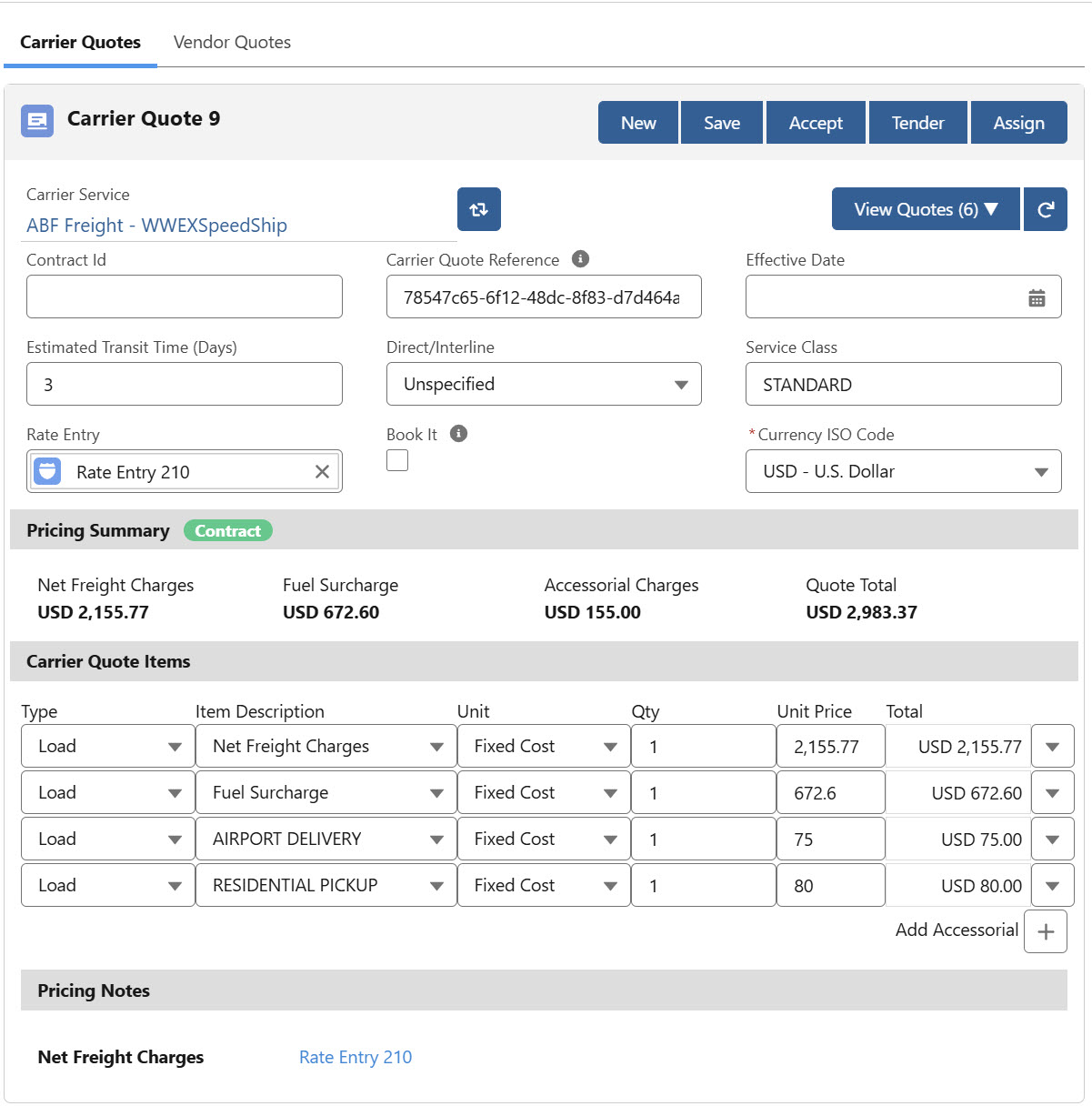
    • When third-party quotes are returned from the Banyan or Project44 integrations, the Vendor field is populated based on the third-party SCAC returned in the Carrier Quote.

  • The Carrier Service lookup field in the Lane Preference LWC excludes disabled Carrier Services and Vendor-type Carrier Services from the search results.

  • The Equipment Type picklist field in the Load Configuration LWC excludes disabled Equipment Types from the list of values for the Mode selected.

  • Enhancements to the Freight Plan Console support adding Expected Ship Date and Expected Delivery Date values for Carrier Loads.

  • The Line Item TMS10 field set supports cloning additional Line Item fields when cloning Loads and Freight Plans. The fields that are cloned by default are Weight, Weight Units, Item Number, and Item Description. Add additional fields to this field set to include them in the cloning process.

  • Fuel Surcharges support decimal precision to 3 figures. The fields impacted include the Fuel Surcharge Percent Start, Percent Increment, and Fuel Surcharge Entry Percent fields.

  • If tendering a Load fails in the Quote Wizard LWC, the Customer Portal sends two Tender Failure emails with a more descriptive error message and advises the user to contact support.

  • Enhance the tracking update logic of the Trucker Tools integration to convert the timestamp from the payload to the timezone of the Stop. If no timezone is indicated, the timestamp is displayed in UTC.

  • Clarified the help text on the Portal Quote Weight Threshold field to better support Load weight threshold limits when creating Loads in the Customer Portal.

  • Enhance the Chatter Feed in the Related Records LWC of the Fleet Management Console to allow Platform Profile users to view Chatter posts.

  • Enhance the outbound EDI 214 transaction to include latitude and longitude for all statuses.

    • Stop event statuses (Arrived, Departed, Appointment, Loading Complete, and Unloading Complete) use the geolocation values of the Account’s Shipping Address on the Stop’s Location field. If the Account does not have geocodes for the Shipping Address, then the Last Reported Geolocation field of the Load is used for event statuses for that Stop.

    • All other statuses, such as In Transit, use the Last Reported Geolocation field of the Load.

  • See the Field Set Summary for more information on new field sets included in the Fall ‘25 release.

    • Customer Quote TMS2 (not new, but was previously unused)

    • Carrier Quote TMS11

    • Line Item TMS10

    • Line Item TMS11

    • Load TMS40

    • Load TMS41

    • Stop TMS14

    • Stop TMS15

    • Trip Plan TMS1

    • Trip Plan Leg TMS1

    • Trip Plan Leg Asset TMS1

    • Trip Plan Segment TMS1

Accounting Seed Bridge Enhancements

  • Enhanced the TransportationBillPDF Visualforce PDF Pages to support the deficit rating information in the Transportation Fees section.

  • Update the TransportationBillBulkController class from public access to global access to allow flexibility in creating a custom bulk invoice document.