Fuel Surcharges (FSC) work much like accessorial charges. Fuel Surcharges are extra fees allocated to the Load rate to cover varying retail diesel prices. The Energy Information Administration (EIA) provides weekly updates on retail diesel prices to help accurately calculate Fuel Surcharges.
Fuel Surcharges can be automatically applied to Customer Quotes, Customer Invoices, Carrier Quotes, and Carrier Invoices. They can be applied via Rate Entries when setting up stored rates for Customer and Global Transportation Profiles.
Create Fuel Surcharges
To create a Fuel Surcharge schedule, navigate to the TMS Admin → Pricing → Fuel Surcharges. Enter the following fields in the Fuel Surcharge Creation LRP to build an entry table:
Field Name | Field Type | Field Description | Field Options |
|---|---|---|---|
Name | Text | The title of the created Fuel Surcharge. | |
Fuel Surcharge Source | Picklist | The location where the Fuel Surcharge is derived from. |
|
Fuel Index | Lookup | The related Fuel Index record used for calculation. | |
Current Week Start Day | Picklist | The start weekday of the Fuel Surcharge calculation.
|
|
Fuel Index Value | Picklist | The date type range, such as week or month, that determines the Fuel Index to use and apply calculation.
|
|
Fuel Index Start | Text | The starting or lowest pricing point for the diesel fuel schedule. | |
Fuel Index End | Text | The ending or highest pricing point for the diesel fuel schedule. | |
Fuel Index Increment | Text | The Fuel Index interval amount applied from entry to entry. | |
Type | Picklist | The type of Fuel Surcharge table. |
|
Rate Start | Text | The initial amount for Rate per Mile Fuel Surcharge tables. | |
Rate Increment | Text | The Rate per Mile interval amount applied from entry to entry. | |
Auto-Update Quotes/Invoices | Picklist | An option to update Fuel Surcharges on quotes and invoices automatically if the Fuel Index changes.
|
|
Once these fields are entered, click Build Entry Table to view the Fuel Surcharge schedule.
Note: The Fuel Surcharge rate on the Customer and/or Carrier Quote is set according to the Load's Expected Ship Date. For Loads with an Expected Ship Date that occurs in the future (beyond the current week), the current fuel rate is used for the Fuel Surcharge rate.
Fuel Surcharge Entry Table Interpretation
The Fuel Surcharge Entry Table is organized by price intervals and displays the following headers:
Entry
The Fuel Surcharge entry identifier.
From Value (>=)
The lowest national/regional pricing point for retail diesel.
To Value (<)
The highest national/regional pricing point for retail diesel.
Rate
The rate increment amount.
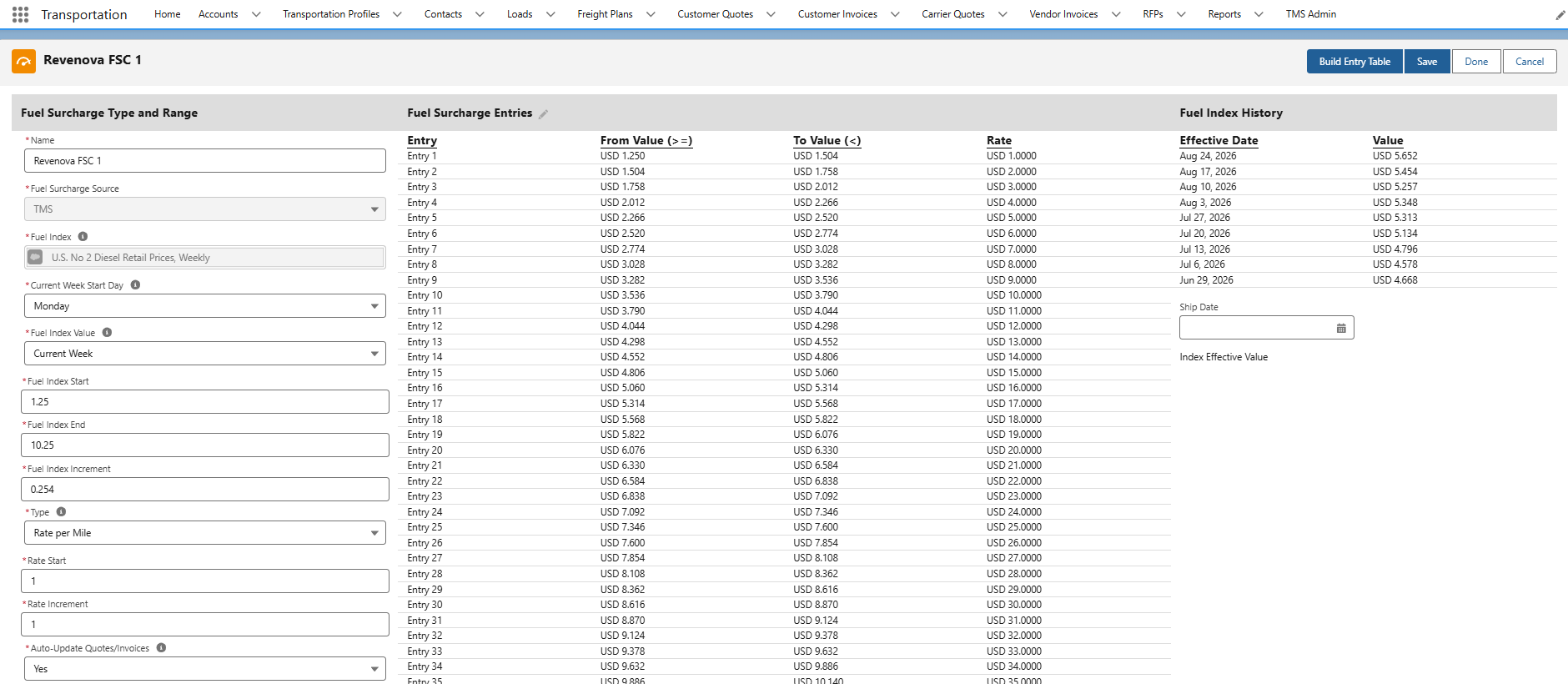
Change the Fuel Index Increment and Rate Increment fields to see broader or granular entry results. The Fuel Index History table on the right side displays historical retail diesel integrated from the EIA.
Enter a Ship Date to view recommended Fuel Surcharge rates from previous dates.
Note: Although it’s possible to select future dates, keep in mind that the EIA updates the Fuel Index weekly on Monday. Any future dates will include the same price point, and do not forecast future price points.
Fuel Surcharge Calculation
When TMS is selected as the Fuel Surcharge Source, Fuel Surcharges are auto-calculated. Keep in mind that when the Fuel Surcharge Source is Breakthrough Fuel, Fuel Surcharges aren’t automatically calculated in the TMS because they rely on real-time lane data.
The following records are automatically updated based on changes to the relevant Fuel Index if they were created via stored rates:
Customer Quote: Updated until Load Ship Date.
Carrier Quote: Updated until Load Ship Date.
Customer Invoice: Updated until the invoice is no longer in the Pending status.
Carrier Invoice: Updated when the customer invoice is no longer in the Pending status.
This recalculation happens to consider the contracted Fuel Index value and its delayed availability at the time of record creation. When creating Fuel Surcharges, ensure the Auto-Update Quotes and Invoices field is set to Yes, or quotes and invoices will need manual adjustments as Fuel Indexes are updated.
For the following types of Rate Entries, the Fuel Surcharge is automatically calculated along with a complete Customer or Carrier Quote:
Fixed Cost
Distance-Based
Weight-Based
Billable Weight-Based
Handling Unit-Based
Linear Feet-Based
Equipment-Based