The Send Email Lightning Web Component (LWC) allows users to send emails for various actions in the Load lifecycle. For more information on creating documents, see the Document Generation LWC.
Note: The heading of the modal changes depending on which action is occuring. For example, “Tender Email” for tendering a Load to a carrier or “Customer Quote Confirmation” for sending a quote to a customer.

The following actions are available on the Send Email LWC:
Assigning a Load to a Carrier
Tendering a Load to a Carrier
When sending a Load Tender to a Carrier, the Tender Method field on the Carrier Service must be set to Email.
Sending a Quote to a Customer
Sending an Invoice to a Customer
When sending a Customer Invoice, the Billing Method field on the Customer Transportation Profile must be set to Email.
Sending an Appointment Request to a Shipper/Consignee
Note: Sending emails in bulk with the Twilio integration is also available in the Send Email LWC.
Caution: Salesforce requires User email addresses to be verified for accountability and security. If a User is encountering issues when attempting to sending emails, confirm that the email address is verified. See the Getting Started guide for steps to verify the email address.
General Settings
The Send Email LWC features some settings that apply to all email actions.

For the Reply-To Email fields, refer to the Reply-To and Organization-Wide Email Address document for more information.
Load Emails automatically populates the recipients in the Send Email LWC for the Load. Refer to the Load Emails document for instructions on setting up this feature.
New Contact or Add Email
Select New Contact to create a new Contact in the Send Email LWC. If the Source is set to an Account, it populates the Account Name lookup field. Enter the name and email address, then select Save.

The new Contact is automatically populated in the Recipient field.
Note: The new Contact does not automatically get the same value in the Role in the Contact’s Transportation Role field.
Enter the email address of the recipient and select the Add Email button to add the email address without creating a Contact. The added email address will not have an icon.

Note: If a Contact already exists for the Account with the same Transportation Role value in the Role field, then the New Contact and Add Email options are not available.
Attached Additional Documents
Attach documents directly to the email with the Upload Files button/drop zone.
Select the Source value to find the files to attach to the email. Depending on the email action being taken, the following options are available to select from:
Load
Customer Quote record
Carrier Quote record
Customer Invoice record
Some documents are generated and automatically attached depending on the email action, for example, when sending a quote to a customer.
Upload documents to attach in the File Viewer so they are available to attach to the email for the Load source. All other sources use the Files related list in their respective records.
Select a file in the Available Documents field, then select the Attach Documents  button to attach it to the email. The file is added to the list of Attached Documents field that populates when there is at least one file attached.

Select the arrow next to the Preview Attachments section to view all attachments.
Note: PNG attachments are downloaded to your computer system instead of being available to preview.

Assign/Tender to a Carrier
Send a notification to the Carrier with the Send Email LWC. Click the Tender or Assign buttons on the Carrier Quote Builder or Carrier Quote List LWCs.
Select either the Tender and Assign buttons to determine the communication type to send the Carrier.
Choose the Email Template from the picklist. The default selections are provided first automatically, but other templates may be selected.

The Source, Role, and Recipients fields automatically populate with the Tender contact information for the Carrier. Remove or change these selections as needed.

Any default CC or BCC email addresses are included when setup accordingly. See Load Emails for including additional email recipients.
A default subject line is provided with the Load number. The Quote Total field is included on the LWC for reference to the user.
In a rich text editor, the body of the email is displayed based on the template settings for the email type.
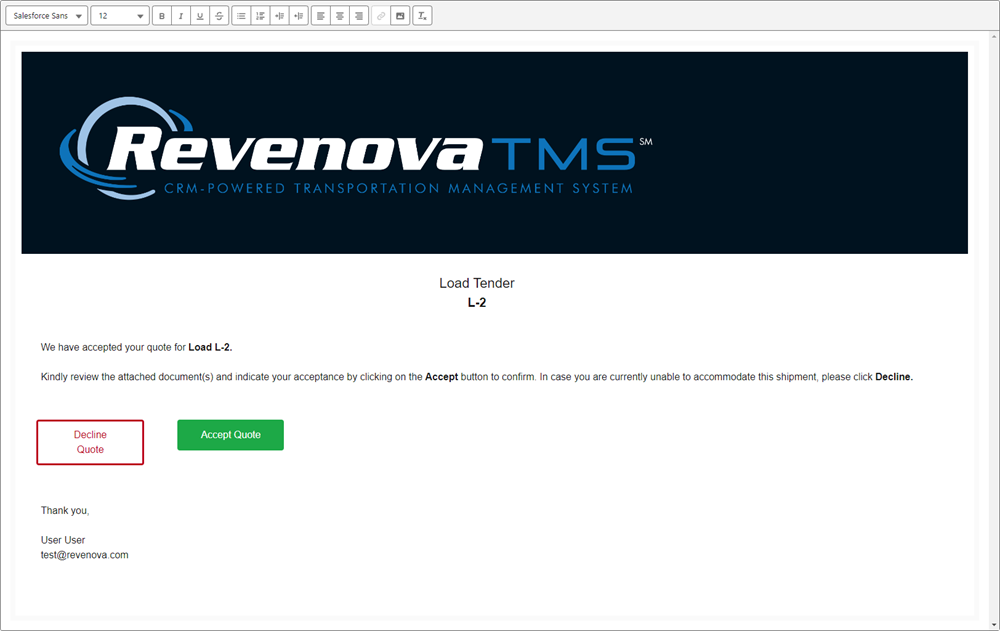
Avoid using delete or backspace keys in the email editor. They clear all of the text from the email. Instead, remove unwanted text with the "Cut" function.
View any attached documents with the Preview Attachments button.
New email attachments are not generated until the email is sent unless a user previews attachments.
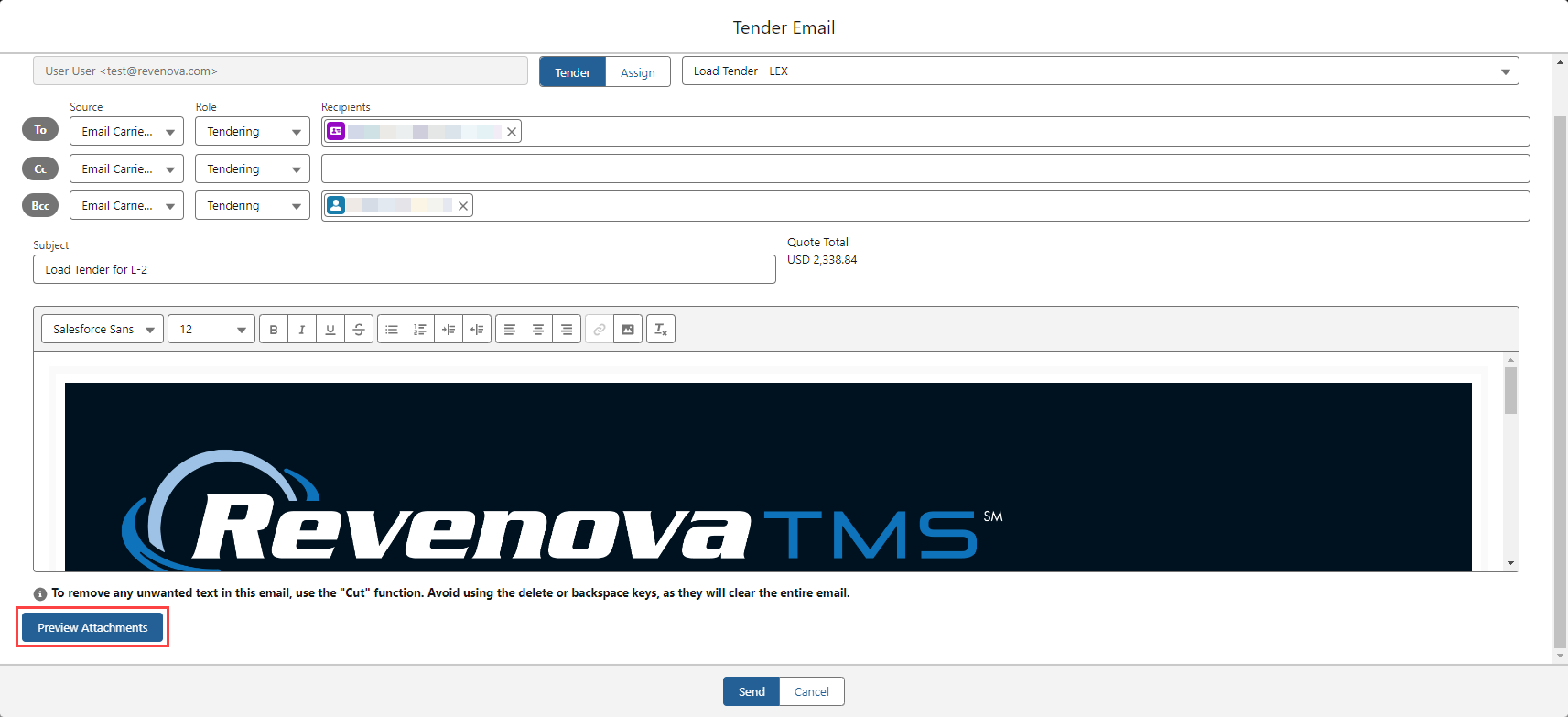
Add more documents from the Load or Carrier Quote objects, or upload local files.
Each file is limited to a size of 2GB.
.png "Send Email LWC - 2(1).png")
Once a file is uploaded to the Load, the + button attaches it to the email.
Click Send.
A message confirms that the email was placed in the outgoing queue.
If an error occurs during the Generate Attachments or Send Email tasks, an Error Log entry is created.
Send a Customer Quote Confirmation
Send a Customer Quote Confirmation with the Send Email LWC by clicking on the Send button on the Customer Quote Builder.
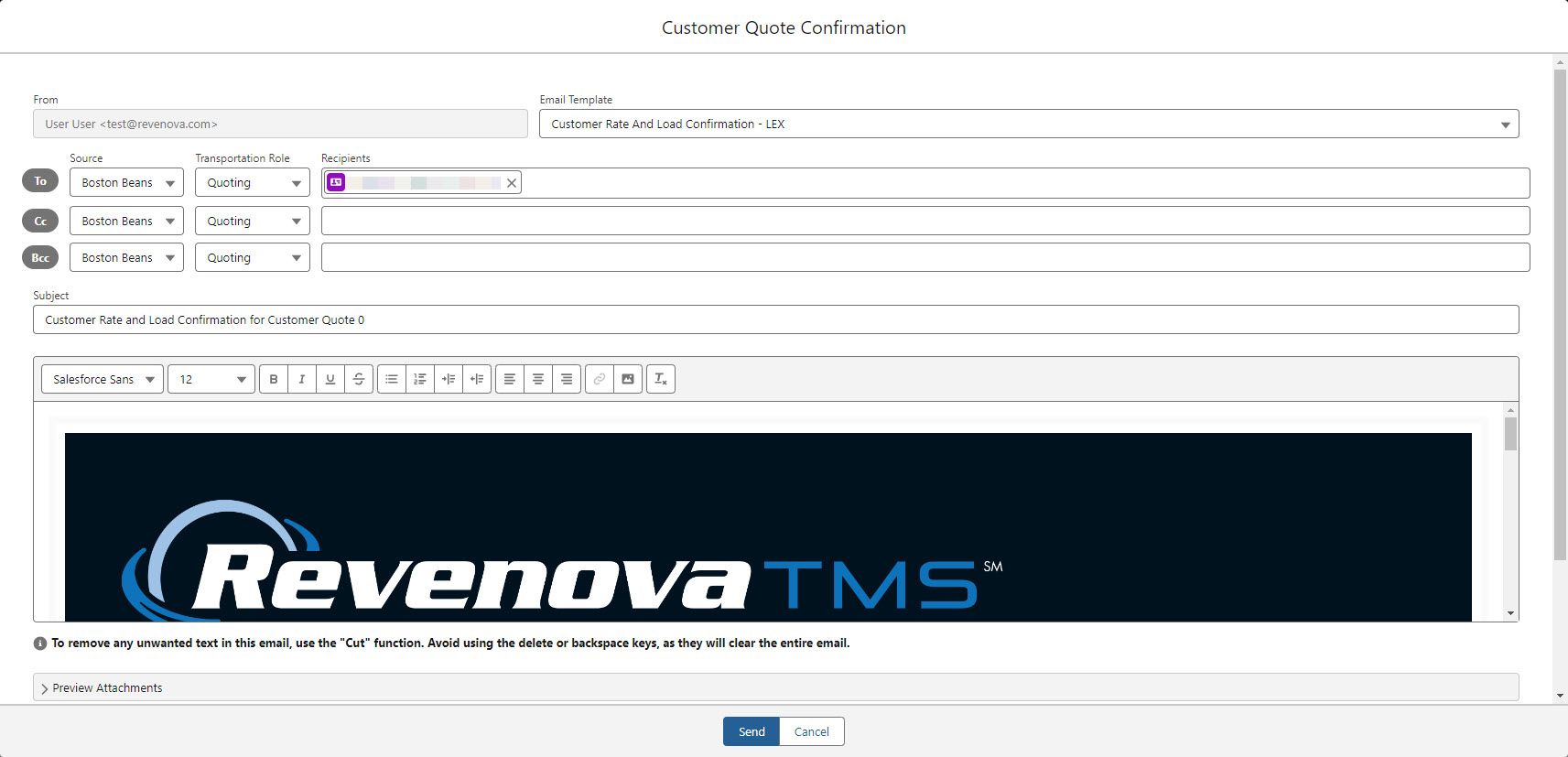
Select the Email Template from the picklist. The default is provided automatically, but other templates may be selected.
The Source, Role, and Recipients fields automatically populate with the Quoting contact information for the customer. Remove or change these selections as needed.
Any default CC or BCC email addresses are included when setup accordingly. See Load Emails for including additional email recipients.
A default subject line is provided with the customer quote number.
In a rich text editor, the body of the email is displayed based on the template settings for the email type.
An attachment previewer displays any other documents included on the email.
Add more documents from the Load or Customer Quote objects, or upload local files.
Click Send.
Send Customer Invoice
Send the Customer Invoice with the Send Email LWC by first clicking on the Generate and Send button on the Customer Invoice Banner LWC.
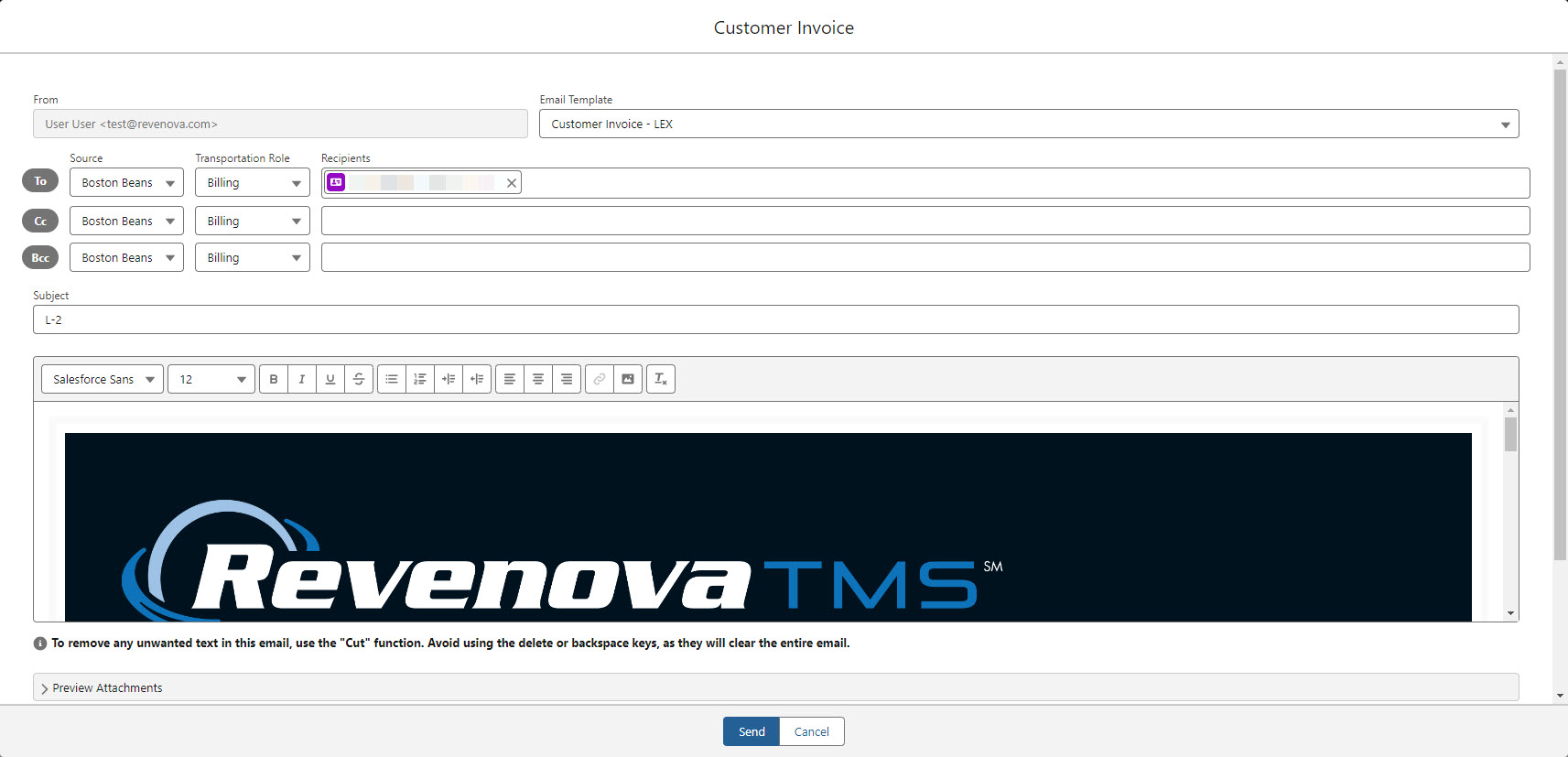
Select the Email Template from the picklist. The default selections are provided first automatically, but other templates may be selected.
The Source, Role, and Recipients fields automatically populate with the Billing contact information for the customer. Remove or change these selections as needed.
Any default CC or BCC email addresses are also included. See Load Emails for including additional email recipients.
A default subject line is provided with the Customer Quote number.
In a rich text editor, the body of the email is displayed based on the template settings for the email type.
An attachment previewer displays any other documents included on the email.
Add more documents from the Load or Customer Quote objects, or upload local files.
Click Send.
Send Appointment Requests
Send an Appointment Request using the Send Email LWC by selecting the Send Appointment Request button in the Load Detail LWC or the Send Email Appointment Request button in the Appointment Setting section of the Fleet Management Console or Appointment Console LWC.

The following are settings the User can view and edit before sending the email:
Select the Email Template to use.
The default template is the one selected in Document Options for Appointment Request and is provided automatically first, but other templates can also be selected.
Set the Appointment Request Expiration field with the date and time.
The default date and time are set according to the value in the Default Appointment Request Expiration field in the Customer Transportation Profile or the Global Default Transportation Profile.
Note: If both Transportation Profiles have the field blank, the default is 24 hours from the current date using the User’s time zone.
If the field is blank, the appointment request does not expire.
By default, the Source field is set to the customer, the Role field is set to Appointments, and the To Recipient field is set to the Contacts with the Appointments role.
The User sending the email is also attached as a Bcc recipient.
Remove or change these selections as needed.
The subject line defaults to: “Appointment Request for {list of Load Numbers}”.
In a rich text editor, the body of the email is displayed based on the template settings for the email type.
Email Body Notes
For the TMS packaged Appointment Request email templates, the following settings/merge fields are used in the body of the email:
The User’s Name
The User’s Phone
The User’s Email
The User’s Company Name
The Stop TMS16 field set
The appointment request expiration is dynamically updated based on the Appointment Request Expiration field. The date format is YYYY-MM-DD, the time format uses the 24-hour clock, and the time zone is set based on your browser or computer system’s time zone—not the User’s time zone.
Once the email is configured, select Send.