The Accounting Seed-based process flow creates the following records.
Customer Quote → Billing
Carrier Quote → Payable
The TMS Invoice and Payment objects are completely bypassed when Accounting Seed is installed in an org.
Payment Terms
The TMS automatically populates Payment Terms records from the Carrier Payment Terms field onto Carrier Quote records from the associated Vendor’s Transportation Profile. Payment Terms are inserted onto Carrier Quotes on the following cascade order.
Carrier Transportation Profile
Global Transportation Profile
If no Payment Terms populate on the Carrier Quote, the Payable generated from the quote includes the Invoice Due Date field set to 15 days after the Invoice Date.
The following actions control the Payment Terms population onto a Carrier Quote.
Payment Terms are only inserted when the Carrier Quote is created.
Payment Terms are not inserted on the Carrier Quote from the associated Carrier Service.
Auto-Creating Invoices
Billings and Payables may be automatically created based on the triggering events set in TMS Admin → Configuration under the Invoice Processing heading.

Create a Billing from the Customer Quote related list by selecting the Customer Quote and clicking the Create Billing button.

Create a Payable from a Carrier Quote related list by selecting the Carrier Quote and clicking on the Create Payable button.

Both Carrier type and Vendor type Carrier quotes create Payable records.
The Vendor Payment Terms field determines the Payment Discount and Due Date for the corresponding Payable.
Confirm that History Tracking is turned On for all settlement fields, especially fields the Carrier enters.
The Vendor Invoice Number and the Vendor Invoice Date fields on the Carrier Quote are used when auto-creating the Vendor Invoice.
Payables contain a Freight Surcharge line that is populated from the Freight Surcharge field on Carrier Quotes returned from SMC3 RateWare. The Freight Surcharge field is only populated with the response from SMC3 RateWare, or a value is manually entered.
Credit Memo Auto-Application
When a Load-specific Payable is posted, any outstanding Credit Memos for that Load is automatically applied to the Payable.
Carrier Remit To Admin (AS) LWC
The Carrier Remit To Admin LWC (AS) provides allows for sending load financial information to a Factoring company or other vendor. Loads display that contain zero Payables. Loads must also be in one of the following status:
Assigned
Dispatched
In-Transit
Delivered
Completed
All Payables display in the LWC except those with a Payment Status of Paid.
Add additional fields to the LWC with the Load TMS21 and Payable TMS1 field sets. The fields shown below are contained in the Payable TMS1 field set.
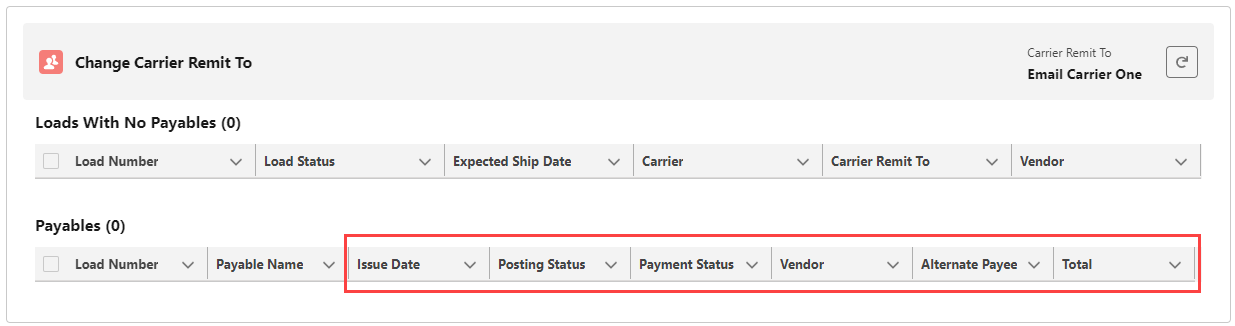
Sample Accounting Seed Carrier Remit To Admin LWC:
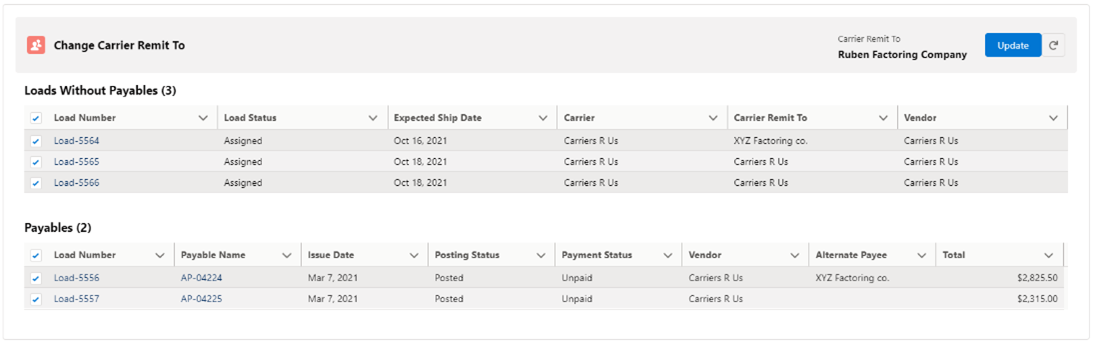
See more information on the TMS Carrier Remit To Admin LWC here.
Troubleshooting
The error 'Attempt to de-reference null object' is caused by a line of code that is searching for a value that does not exist because a particular field value is null.
Issue
Attempting to create a Billing generates an error message. "Attempting to dereference null object." This error is caused by a line of code that is searching for a value that does not exist. The field value is null. There are a variety of reasons that may cause this error.
Resolution
From Customer Invoice Documents → If any row is set to Include if Accessorial Present, the associated accessorial charges must be linked. Use the Add button to include the accessorial charges. The TMS checks if those accessorial charges are present on the Billing record before appending the invoice.
Check the Billing Contact related to the Account. Billing contacts may have been added after the Billing records were generated. Manually populate the Contact on the Billing record.
The Billing Contact email field must be populated with a valid email address. The email address cannot be in the First Name or Last Name fields.